TRAO Key Science Program
TIMES: mapping Turbulent properties In star-forming MolEcular clouds down to the Sonic scale
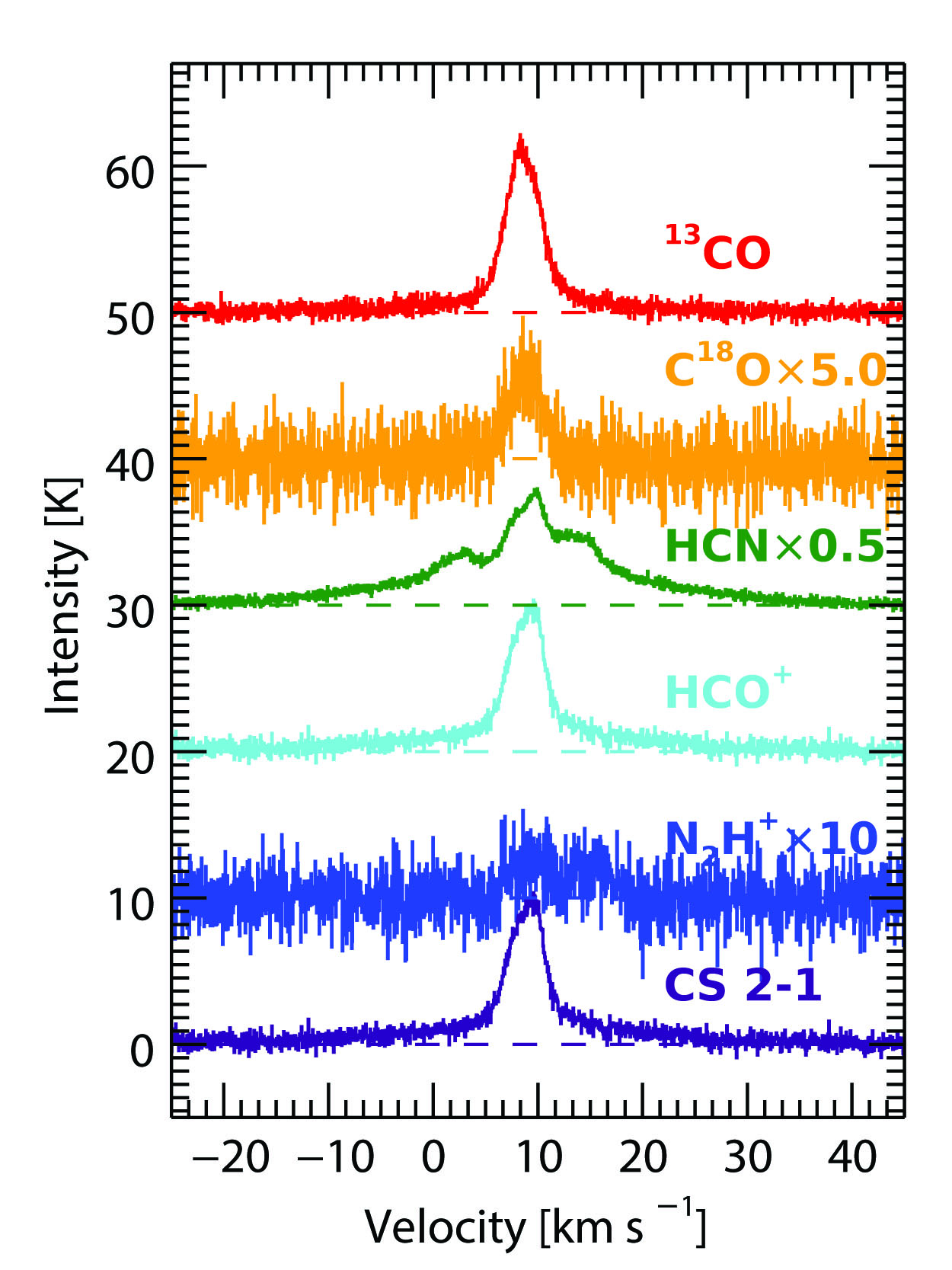 Figure 1. The observed 13CO, C18O, HCN, HCO+, N2H+, and CS lines toward Orion KL (Yun et al. in prep.).
Turbulent molecular clouds are the sites of stellar birth. Its supersonic motion determines the density and velocity fields of the clouds and can affect the gas kinetic temperature as it decays via shocks. The turbulent motion, thus, is closely related to the ongoing star-forming activities. However, despite its central role in star formation and many years of study, the properties of turbulence remain poorly understood.
In order to study the relation between the turbulence and the different star-forming environments, we proposed a Key Science Program of Taeduk Radio Astronomy Observatory (TRAO-KSP), "mapping Turbulent properties In star-forming MolEcular clouds down to the Sonic scale" (TIMES; PI: Jeong-Eun Lee). The proposed observing time is 1200 hours and we map fully massive and low-mass star-forming molecular clouds. We observe the Orion A and Ophiuchus clouds that are well known nearby active star-forming regions. In order to sample turbulent properties across a broad range of densities and scales, we map both clouds in six different density tracers: 13CO J=1-0, C18O J=1-0, HCN J=1-0, HCO+ J=1-0, N2H+ J=1-0, and CS J=2-1.
 Figure 2. The Integrated Intensity maps of the observed lines towards the Orion A (upper panel) and Ophiuchus (lower panel) molecular clouds (Yun et al. in prep.).
The obtained data have a uniform noise level (0.4 K for the 13CO/C18O, HCN/HCO+ data and 0.15 K for the N2H+/CS data) with a high-velocity resolution (~ 0.05 km/s) and it is proper to study the turbulent properties using statistical methods, such as the Principal Component Analysis (PCA) and Spectral Correlation Function (SCF). Especially, PCA is one of the way to recover a power spectrum of turbulence from the observed cube data. We analyzed the observed 13CO J=1-0 data using PCA and find that turbulent power spectra of the entire Orion A and Ophiuchus molecular clouds follow the universality of turbulence proposed by Heyer & Brunt (2004). However, the typical turbulent motions in the subregions within the observed area are different, and the PCA result for the active star-forming regions shows the higher velocity dispersion (δv) values than the other subregions. Those high δv values can be a good diagnostic tool for searching active star-forming regions within the clouds when we cannot access a spatial distribution of young stellar objects.
