PURE-C: Disk Model
Package of Unified modeling for Radiative transfer, gas Energetics, and Chemistry
PURE-C (Lee. S., et al. 2021, ApJ) is a modeling package to compute the physical (gas and dust temperature) and chemical structure of a protoplanetary disk self-consistently and to synthesize molecular line spectra from the protoplanetary disk. Thus, the spectra observed with ALMA could be reproduced and could be understood by modeling with PURE-C.
This package is updated from the Photon Dominated Region (PDR) model which applied to the UV-heated outflow cavity wall to explain the warm CO gas with the universal excitation temperature of 300 K (Lee, S. et al. 2014, 2015). In order to apply PURE-C to the protoplanetary disk, we solved the all problems in the two-dimensional spherical polar coordinate (r,θ) and added the surface chemistry to reproduce Complex Organic molecules (COMs). Furthermore, multiple-size dust grains can be treated in PURE-C.
PURE-C consists of the following four parts.
- Dust continuum radiative transfer: calculates the dust temperature with a Monte Carlo method and a method of Lucy (1999). In the very optically thick mid-plane of the disk, where the Monte-Carlo method is not efficient, a modified random walk method (Min et al. 1999, Robitaillie 2010) is applied.
- Gas energetics (PDR code): finds the gas temperature balancing between heating and cooling processes. Ultraviolet(UV) radiation strength and visual extinctions (Av) are derived from the UV radiative transfer, then the chemistry with a small network and gas energy balancing problems are solved iteractively.
- Chemistry: calculates the chemical compositions up to COMs. This contains reactions on the dust grain (Langmuir-Hinshelwood mechanism) as well as gas phase and gas-grain interactions.
- Non-LTE line radiative transfer: calculates level-population and synthesize line spectra for the molecules.
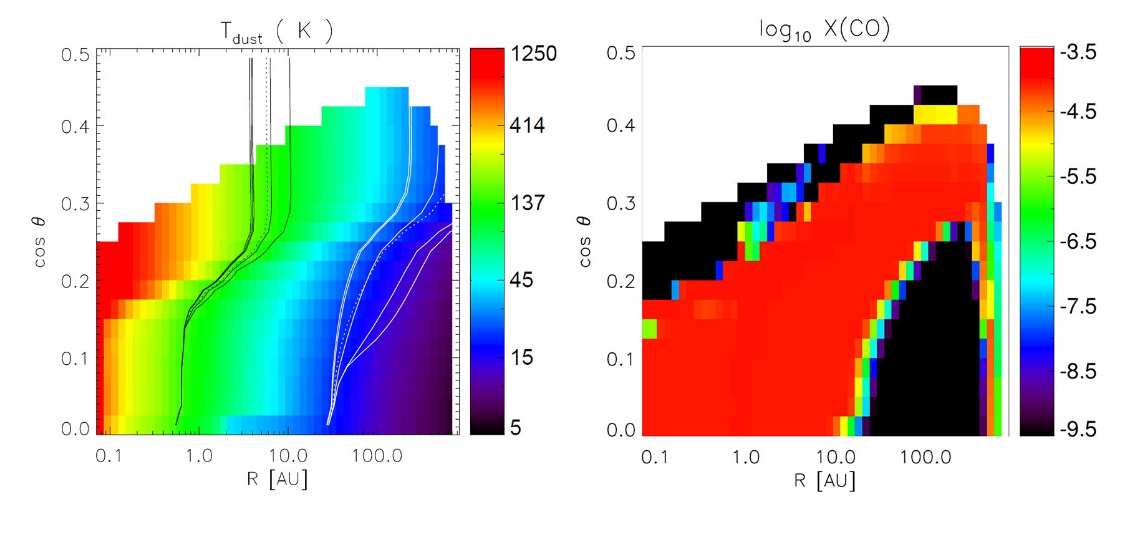 Figure 1. Dust temperature and CO abundance distribution for the disk model in the spherical polar coordinates (r,θ). Left: Black and white solid lines indicate the water and CO snowline for different grain sizes, respectively: the snow line of the smaller grain is located further from the protostar. Dotted lines show the snow lines for the acculturated single dust grain. Right: CO molecule is photodissociated in the atmosphere near the protostar and is freeze-out onto the dust grain outside the CO snowline (Lee. S., et al. 2021, ApJ).
