EPISODE
EPISODE: EC 53, the only known Periodically variable Infant Star to chase the Outburst in the next Dynamical Event
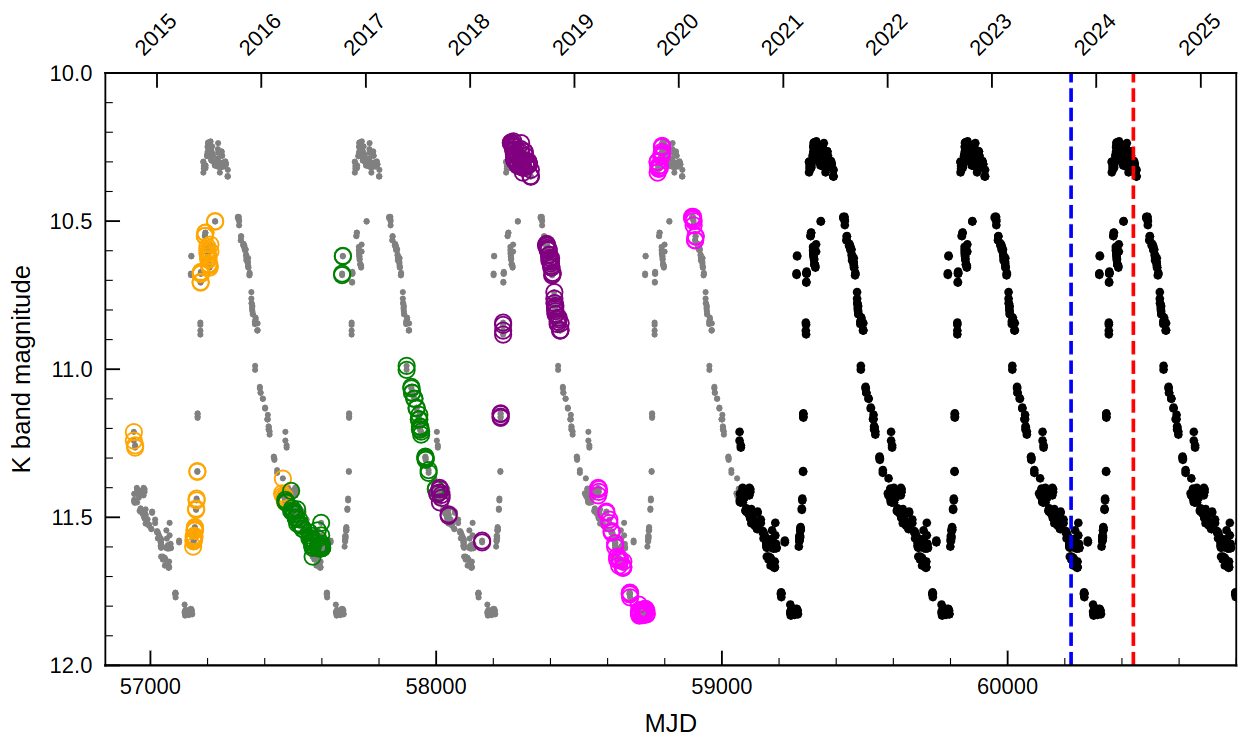 Figure 1. K-band light curve of EC 53.
Blue and red dashed lines indicate the JWST observation dates for the quiescent and burst phases (Jeong-Eun Lee et al. 2026).
EC 53 is a Class I protostar and was the first submillimeter variable source identified by the JCMT Transient Survey. It shows quasi-periodic variability with a period of approximately 1.5 years, which is due to cyclic changes in the accretion rate onto the central protostar. We observed EC 53 with JWST in quiescent and burst phases using NIRSpec/IFU and MIRI/MRS. The four studies analyzed each components of the protostellar system : dusty disk, gaseous disk, the jet/outflow, and ice in the envelope.
Paper I : Accretion Burst Crystallizes Silicates in a Planet-Forming Disk (Jeong-Eun Lee et al. 2026)
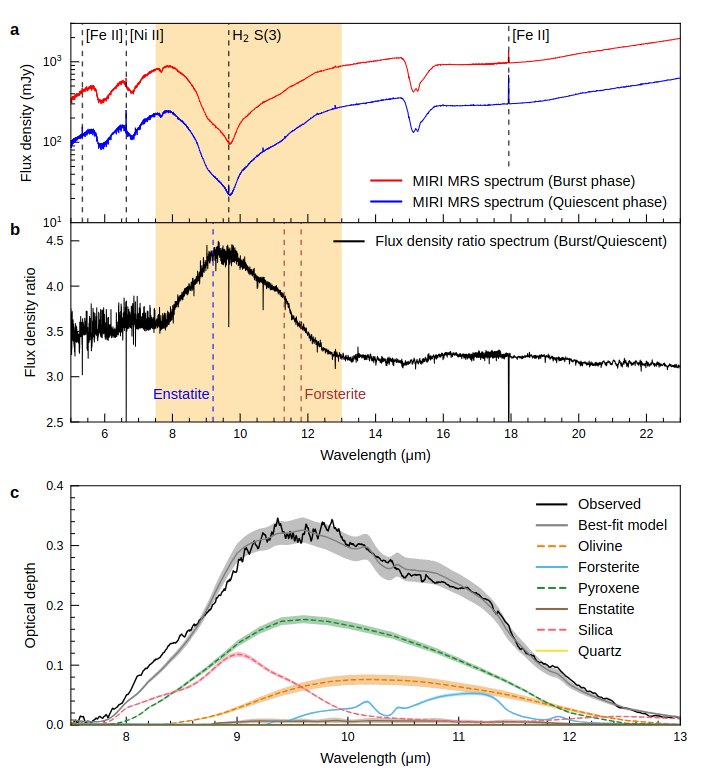 Figure 2. (a) MIRI MRS spectra of EC 53 observed in the burst (red) and quiescent (blue) phases.
(b) Flux density ratio between the burst and quiescent phases.
(c) Optical depth profile (black solid line) of the silicate emission feature emerging in the 7.5–13 μm region during the burst phase.
The combined profile (grey solid line) was composed of synthetic amorphous (olivine, pyroxene and silica) and crystalline silicates (forsterite, enstatite and quartz).
Each silicate component, combined for the best-fit model, along with its error, is presented in different colours.
Silicates are major refractory components of the ISM, and can be either amorphous or crystalline. Most of the protostellar envelope and protoplanetary disk is composed of amorphous silicates, while crystalline forsterite and enstatite can form in the innermost regions of the disk, where high temperatures (>900K) can anneal amorphous silicates. However, crystalline silicates have been detected in comets, where temperatures are low so crystalization can happen. How crystalline silicates exist in regions so far away have been a mystery.
EC 53 shows strong 10 and 18 μm silicate absoprtion in both epochs, from dust in the envelope. However, the burst spectrum revealed a new emission component around 10 μm contaning crystalline forsterite and enstatite features. These emission features were not seen around 18 μm, which can be interpreted as crystalline silicates newly formed by the accretion burst in the innermost, rather than simply heating the pre-existing crystalline silicates.
This interpretation was supported by a radiative transfer model of the EC 53 disk. The burst can expand the region where silicate crystallization happens. Vertical mixing and MHD disk winds can be a channel to redistribute dust grains to larger radii, which could be one way to explain the existence of crystalline silicates in comets.
Paper II : Variability in the CO and H2O Rovibrational Absorption Lines in a Periodically Variable Protostar EC 53 (Seokho Lee et al. 2026)
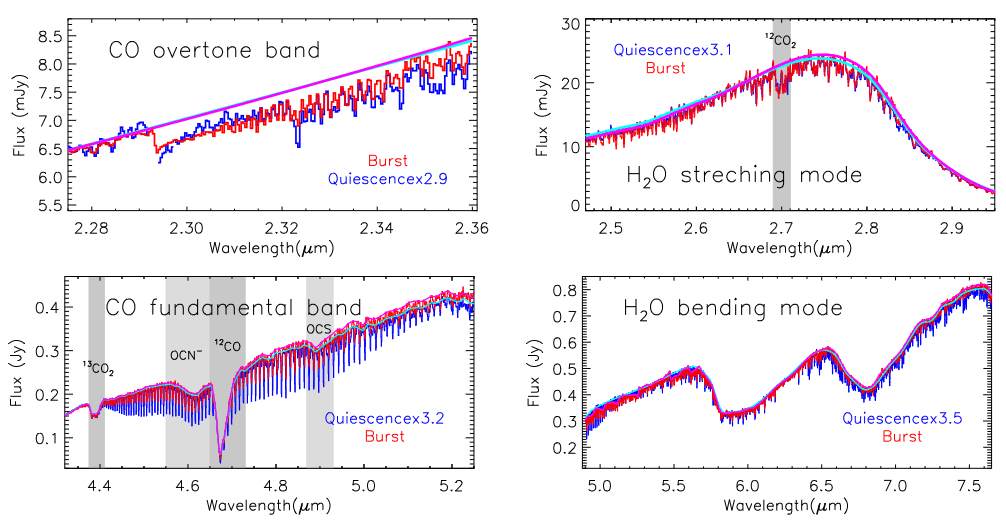 Figure 3. The observed CO and H2O absorption bands.
The burst and quiescent phase spectrum are shown in red and blue, with the quiescent spectrum scaled up to comparable intensities.
The spectrum of EC 53 showed absorption lines in the CO fundamental (~4.6μm) and overtone (~2.3μm) bands and the H2O bending (~6.0μm) and stretching (~2.7μm) bands, in both quiescent and burst phases. The gas temperatures of the overtone bands were higher than the fundamental bands, supporting the overtone absorption traces hotter gas at smaller radii.
The H2O stretching and CO overtone absorption did not show significant variability. In contrast, CO fundamental and H2OO bending absorption decreased by a factor of 2 during the burst. Detailed analysis including veiling shows that this change can be explained by dilution from the enhanced continuum, rather than an intrinsic change of the absorbing gas. The wavelength-dependent continuum increase suggest that different radii respond differently across the burst cycle.
Paper III : The Nested Jet/Outflow Morphology of EC 53 Revealed by JWST and ALMA (Seonjae Lee et al. 2026)
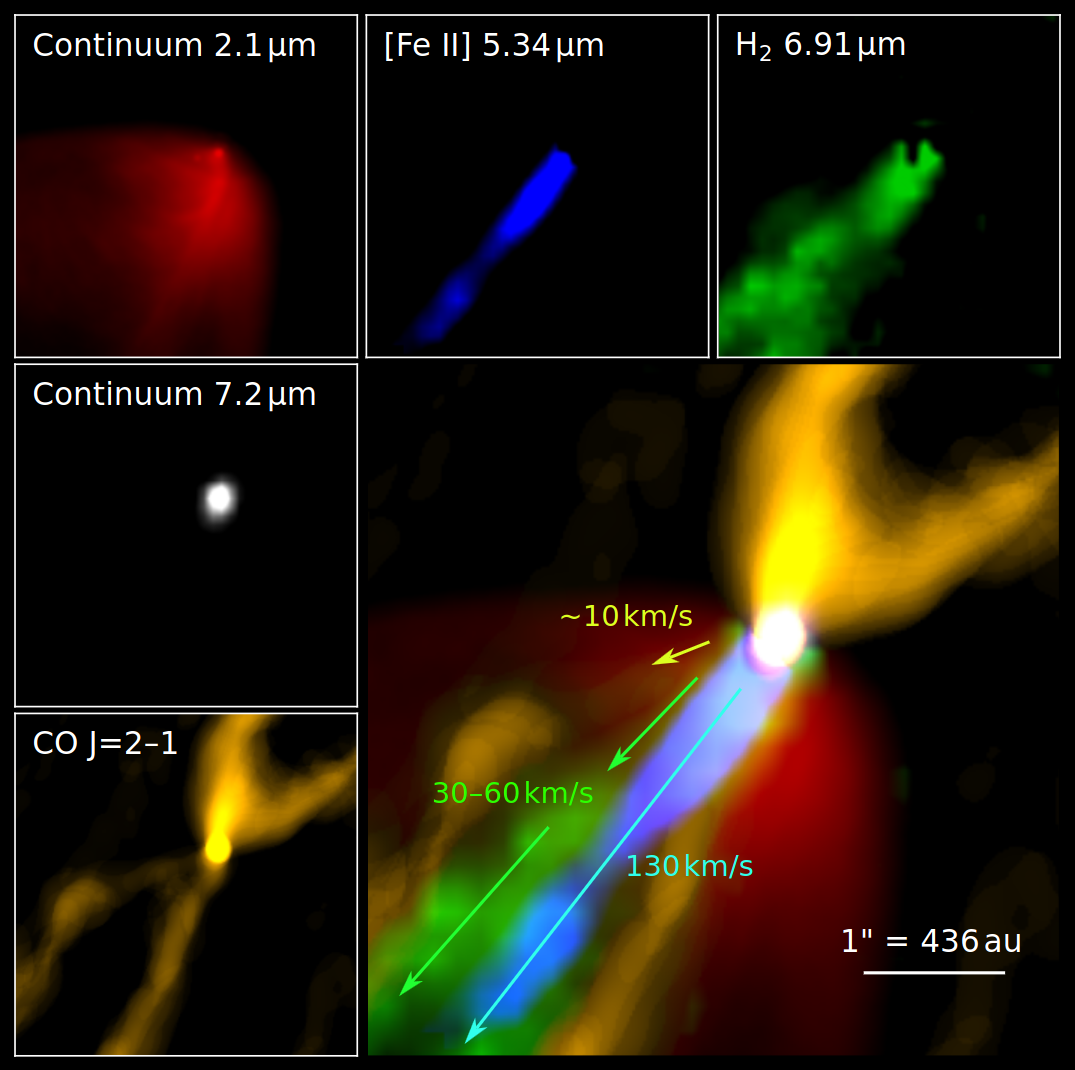 Figure 4. Montage of outflow components of EC 53 observed with JWST and ALMA.
Combined JWST and ALMA observations reveal a nested jet/outflow structure in EC 53. ALMA and MIR continuum emission traced light from the protostar and its surrounding disk. Ionic line emission, such as [Fe II] or [Ne II] traced a high-velocity (~130km/s) collimated jet. H2 emission is shown as a narrow cone-like structure around the ionic jet. 27 H2 transitions were detected, allowing us to use the excitation diagram to derive the temperature and column density of H2, along with the visual extinction. Lower energy transitions exhibit a warm temperature (~900K) with a roughly constant velocity of ~30 km/s, while higher energy transitions are hotter, and gets accelerated along the outflow axis reaching ~60km/s. MIR CO emission follow similar distribution with H2. Cold CO emission from ALMA shrouds the H2 emission, inside the outflow cavity traced by NIR continuum. C2H traces the outflow cavity walls. The combined view shows a nested velocity and temperature structure which is consistent with an MHD disk wind, although other mechanisms such as entrainment may contribute.
Paper IV : Ice Inventory in the Envelope of EC 53 (Jaeyoung Kim et al. 2026)
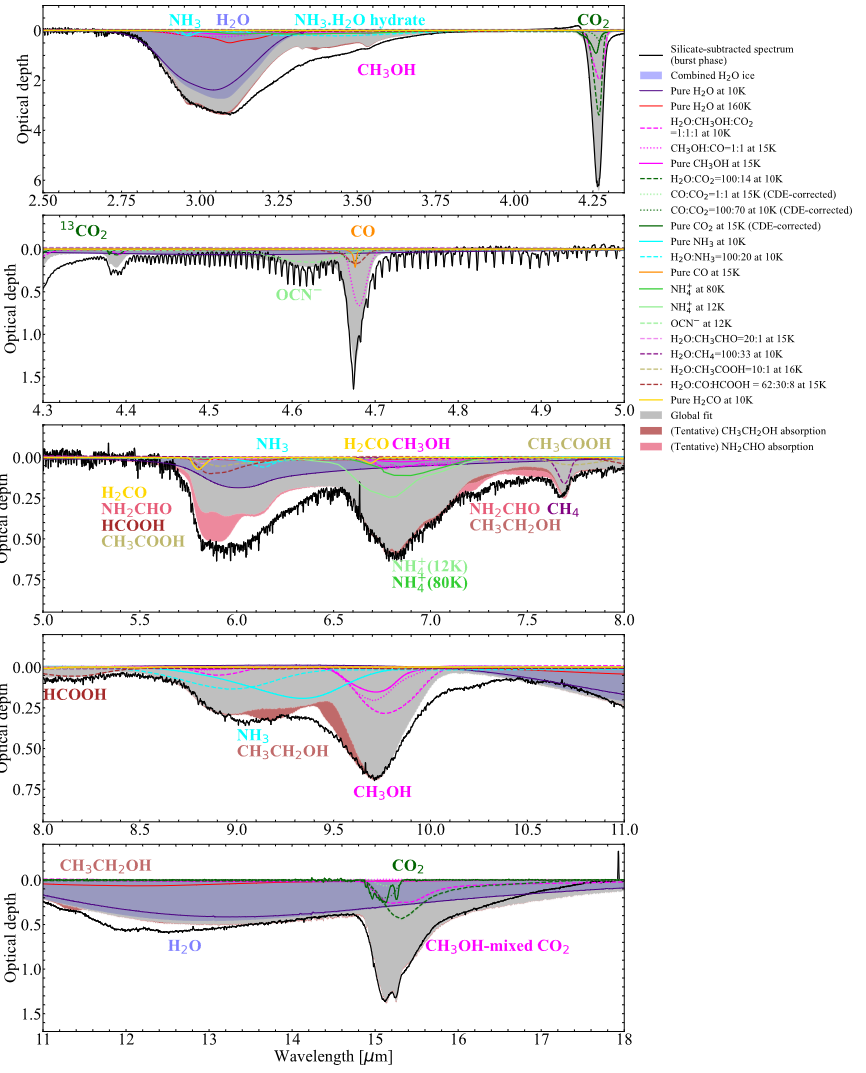 Figure 5. Ice fitting results of EC 53. Each ice component is labeled with different colors.
We utilized a global-fitting method to calculate the ice composition of the envelope of EC 53. After determining the continuum and correcting for broad silicate absorption, there were no significant changes in the ice absorption between the quiescent and burst phase. This indicates EC 53's moderate, short-duration burst is not strong enough to modify the envelope ice reservoir.
Using a global Bayesian fitting procedure, we first constrain the broad H2O ice bands, then consider contributions from CO2, CO, CH3OH, NH3, CH4, OCN-, and NH4+, using laboratory spectra with various temperature/mixture/crystallinity. Minor ice species (HCOOH, H2CO, CH3COOH, CH3CHO, C2H5OH, and NH2CHO) are also considered, although several of these COMs identification remain tentative.
The abundances of major species compared to H2O of EC 53 were significantly larger compared to other embedded protostars. This implies bulk of the ice were accumulated in the cold prestellar stage. In addition, CO2 absorption at 15 μm show a double peaked feature, and H2O absorption requires both 10K amorphous and 160K crystalline ices. This indicates the envelope of EC 53 went though a big heating event beyond cold prestellar conditions. This heating event may enhance additional chemical reactions, increasing the diversity in its ice composition.
