SCOPE
SCUBA-2 Continuum Observations of Pre-protostellar Evolution
SCOPE (SCUBA-2 Continuum Observations of Pre-protostellar Evolution, PI: Tie Liu) is one of the JCMT large programs to study the early evolution of molecular clouds, clumps, and dense cores in a wide range of Galactic environments. Thousands of dense cores within the PGCCs have been identified in the ″SCOPE″ survey, and most of them are either starless cores or very young protostellar objects (Class 0/ I; Liu et al. 2016 ; Liu et al. 2018b ; Kim et al. 2017 ; Tatematsu et al. 2017 ; Tang et al. 2018). The submillimeter dust continuum images of PGCCs can provide an opportunity to study the formation and evolution of cores, because the dust continuum is a good tracer of dense and cold regions. Yi et al. (2018) investigated clumps and cores in the Orion molecular cloud complex (the Orion A, B, and λ Orionis clouds) and found that a massive star gave negative feedback to the core formation and evolution in the λ Orionis cloud.
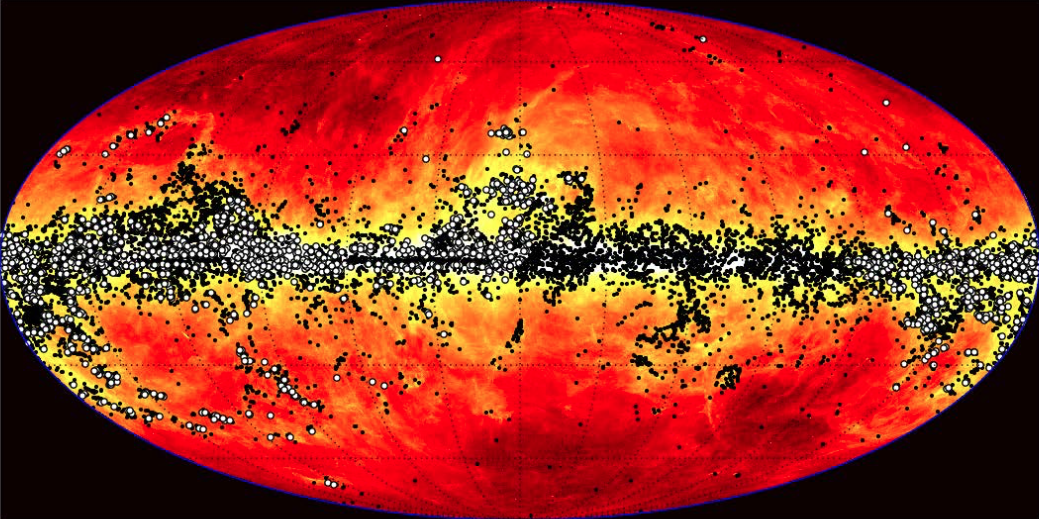
Figure 1. All-sky distribution of the 13188 PGCC sources (black dots) and the 2000 originally proposed PGCC sources (open dots) overlaid on the 857 GHz Planck map (Credit: Mika Juvela).
Further follow-up studies of PGCC (Planck Galactic Cold Clumps; Planck Collaboration et al. 2016) objects have been carried out with ground-based telescopes to investigate the evolutionary conditions of PGCCs. These facilities include the James Clerk Maxwell Telescope (JCMT), the Purple Mountain Observatory (PMO), the Nobeyama Radio Observatory (NRO), the Taeduk Radio Astronomy Observatory (TRAO), the Korean VLBI Network (KVN), the Caltech Submillimeter Observatory (CSO), the Submillimeter Array (SMA), and the Institut de radioastronomie millimétrique (IRAM; Liu et al. 2012, 2013, 2015, 2016; Wu et al. 2012; Meng et al. 2013; Yuan et al. 2016; Zhang et al. 2016b; Kim et al. 2017; Tatematsu et al. 2017; Tang et al. 2018; Yi et al. 2018; Yi et al. 2021). These ground-based studies allow us to improve our understanding of dense cores and star formation in widely different environments at higher spatial resolution than the Planck observations, using different tracers from the continuum to spectral lines (e.g., CO, N2H+, HCO+).
