SPECTRAL Library
IGRINS Spectral Library, as part of Korean IGRINS Legacy Program (PI: Jeong-Eun Lee), provides high-resolution (R ~ 45,000) and high signal-to-noise ratio (S/N ~ 200) near-infrared spectra for a wide range of spectral types (O - M) and luminosity classes (I - V). The spectra were obtained with the Immersion GRating INfrared Spectrograph (IGRINS) covering the full range of the H (1.496-1.780 µm) and K (2.080-2.460 µm) atmospheric windows. The targets were primarily selected from the MK standard stars, which cover a wide range of effective temperatures and surface gravities with metallicities close to the Solar value (Park et al. 2018, ApJ).
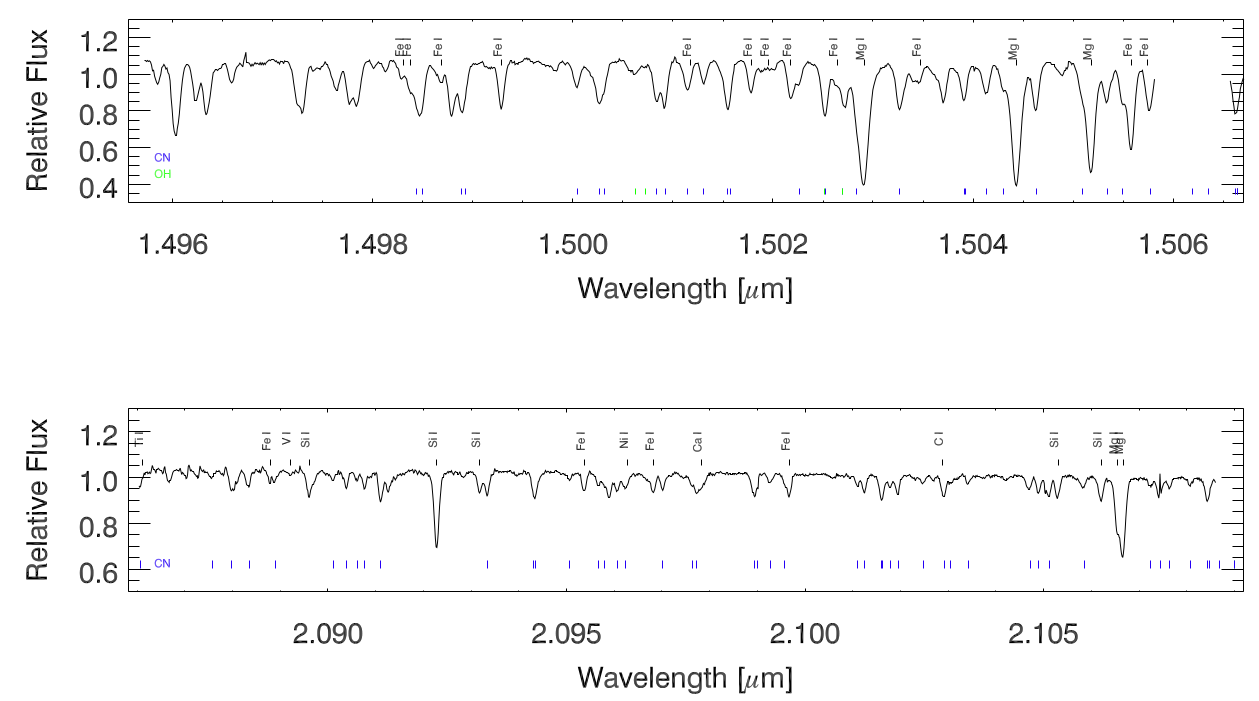
Figure 1. Representative H- and K-band spectra of HD 44391 (K0 Ib). Line identification was made using the Arcturus line list from Hinkle et al. (1995) (Park et al. 2018).
Spectral libraries are important for science efficiency and repeatability. By understanding standard stars very well, we can also study stellar populations and chemical abundances throughout the Galaxy. While a number of stellar spectral libraries are available, many are at optical wavelengths and in low- to moderate-resolution. The number of spectral libraries with high spectral resolution in the near-infrared (NIR) is very limited.
NIR spectral libraries are useful for studying the cool phenomena of the universe: physics of cool stars, circumstellar objects such as planets and disks surrounding young stellar objects (YSOs), and the extended atmospheres of evolved stars. Compared to the red part of their optical spectra, the NIR spectra of cool stars are better suited for detailed spectroscopic study (especially in the J and H atmospheric windows, hereafter bands) as they contain fewer molecular bands. When determining equivalent widths (EWs) the broad molecular bands make the continuum level hard to determine and affect the measurement of narrow atomic lines. Also, the lower extinction in the NIR, relative to optical wavelengths, provides us access to dust obscured stars across the Galaxy. Additionally, a NIR stellar library is useful for population synthesis of cool stars at the wavelengths where they are brightest.
Currently, a uniform library of high-resolution NIR spectra covering all spectral types and luminosity classes is not available. Although low- and moderate-resolution spectra are appropriate for extragalactic studies, because of the faintness of the targets and their internal velocity dispersions of 100 to 250 km s-1 , there is an ongoing need for high-resolution spectral libraries in the Galactic context. One consequence of the absence of such libraries is that only strong and isolated lines have been used for studies. High-resolution NIR spectra will reveal lines with small equivalent widths that can be more sensitive to stellar properties and to abundances of less common elements (Afşar et al. 2016). At R=45,000, lines in most stars are well-resolved and the line shapes offer an additional window into the stellar properties. High-resolution stellar spectra covering wide ranges of effective temperature and surface gravity will test atmospheric models with unprecedented accuracy and permit modeling to improve infrared atomic and molecular line data.
