Survey of Protoplanetary Disks
Physical and chemical structures of the inner gaseous disks provide clues to the planet formation and accretion processes within young stellar systems. The timescale of gas dissipation in the inner disk will set the formation mechanism of the giant planets, i.e., gravitational instability (Boss 1997, Mayer et al. 2002) or core accretion scenarios (Bodenheimer & Lin 2002). Terrestrial planet formation is also very sensitive to the residual gas mass in the terrestrial zone at ages of a few million years since the final mass and eccentricities that are important for the habitability strongly depend on the gas column density in the region (Kominami and Ida 2002). Also, the chemical structure in the inner disk determines the composition of the atmosphere of planets.
The accretion mechanism from the disk to the central stellar object is still in debate. The standard accretion model assumes a steady accretion rate. However, the FU Orionis-type objects (FUors) and Very Low Luminosity sources (VeLLOs) suggest the episodic accretion process; the infalling envelope builds disks that are unstable and repeatedly dump their mass onto the star. If the episodic disk-to-star accretion is the dominant mass increase method in stars, this process also changes the initial conditions for planet formation since the final disk mass and structure at the end of the envelope infall phase will depend on the timing of the last major accretion event onto the star. To study the outburst accretion process and the effect of enhanced heating on disk composition and structure, FUors are excellent targets.
Observations of the inner gaseous disks, therefore, are essential to understanding the formation process of stars and planets since the line features can provide information on accretion, wind, and rotation as well as the timescale gas dissipation and planet formation. Also, relative abundance distributions in the inner disk will provide hints on the compositions in the planet-forming zones as well as the chemical evolution in disks. Although the inner disks are too small to be resolved spatially, they can be studied with high spectral resolution since different radii can be separated in velocity. The accurate measuring of the line width will also be to distinguish the origin of the line, for example, disks, accretion flows, or inner winds.
The Immersion Grating Infrared Spectrograph (IGRINS) is a cross-dispersed near-infrared spectrograph which has high-resolving power (R=λ/Δλ = 45,000). Also, IGRINS can observe H- and K-bands (1.45 ~ 2.5 µm) simultaneously. This high spectral resolution and large wavelength coverage can allow the detection of a lot of species and transitions. For example, The H- and K-bands spectrum include hydrogen recombination lines, in particular, Br γ at 2.166 µm which are believed to arise in the magnetospheric interface between the star and disk with a line strength related to the stellar accretion rate. Molecular hydrogen lines and forbidden iron lines, especially H2 S(1) line at 2.122 µm and [Fe II] at 1.644 µm which have been observed in some YSOs, are known to trace outflows and shocks in disk systems. Also, CO overtone bands are observed in the K-band toward both low- and high-mass YSOs which are believed to have disks. In addition to these, high spectral resolution of IGRINS allows detecting atomic metal lines having weak spectral features which can tell us the physical and chemical environments of protostellar photospheres or disks. The various atomic and molecular transitions can be used to model the geometry and strength of accretion in different disks.
 Figure 1. The frequency of spectral lines seen in the IGRINS spectra of YSOs for each object type (Yoon et al. in prep.).
To explore the physical and chemical structures of YSOs, hence, we have carried out the "IGRINS Survey of Protoplanetary Disks (PI: Jeong-Eun Lee)" from 2014. Proposed YSOs are distributed in wide ranges of evolutionary stages (from Class I to Weak-line T Tauri Stars), mass (from low-mass to intermediate to massive YSOs), and physical states (FUors). We observed total 62 sources; 15 Class I sources, 17 Classical T-Tauri stars, 9 Weak-line T Tauri stars, 8 Herbig Ae/Be stars, 3 massive YSOs, and 10 FUors. Figure 1 shows the frequency of spectral lines seen in the IGRINS spectra of YSOs for each object type. The frequencies of absorption and emission lines are diverse to evolutionary stages, mass, and physical states. However, even in the same object type, the spectral features are different since the detailed physical environments for each source are different. For example, CO overtone band spectra in Figure 2 show different spectral features depending on the object types and also are various in the same object type. We are statistically analyzing the properties of YSOs of various evolutionary stages, masses, and physical states using the IGRINS spectra.
To explore the physical and chemical structures of YSOs, hence, we have carried out the "IGRINS Survey of Protoplanetary Disks (PI: Jeong-Eun Lee)" from 2014. Proposed YSOs are distributed in wide ranges of evolutionary stages (from Class I to Weak-line T Tauri Stars), mass (from low-mass to intermediate to massive YSOs), and physical states (FUors). We observed total 62 sources; 15 Class I sources, 17 Classical T-Tauri stars, 9 Weak-line T Tauri stars, 8 Herbig Ae/Be stars, 3 massive YSOs, and 10 FUors. Figure 1 shows the frequency of spectral lines seen in the IGRINS spectra of YSOs for each object type. The frequencies of absorption and emission lines are diverse to evolutionary stages, mass, and physical states. However, even in the same object type, the spectral features are different since the detailed physical environments for each source are different. For example, CO overtone band spectra in Figure 2 show different spectral features depending on the object types and also are various in the same object type. We are statistically analyzing the properties of YSOs of various evolutionary stages, masses, and physical states using the IGRINS spectra.
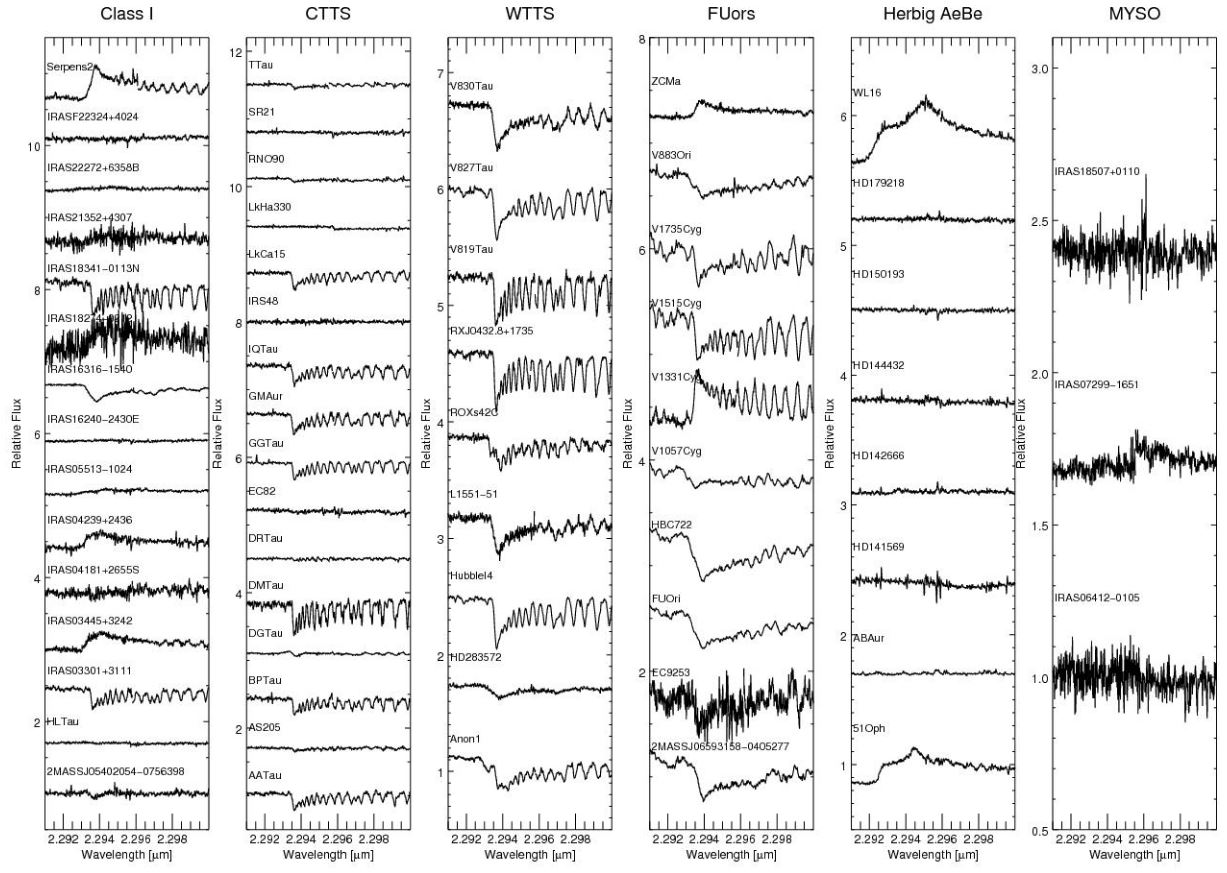
Figure 2. CO overtone v=2-0 band spectra of YSOs for each object type.
