AKARI: Ice Survey
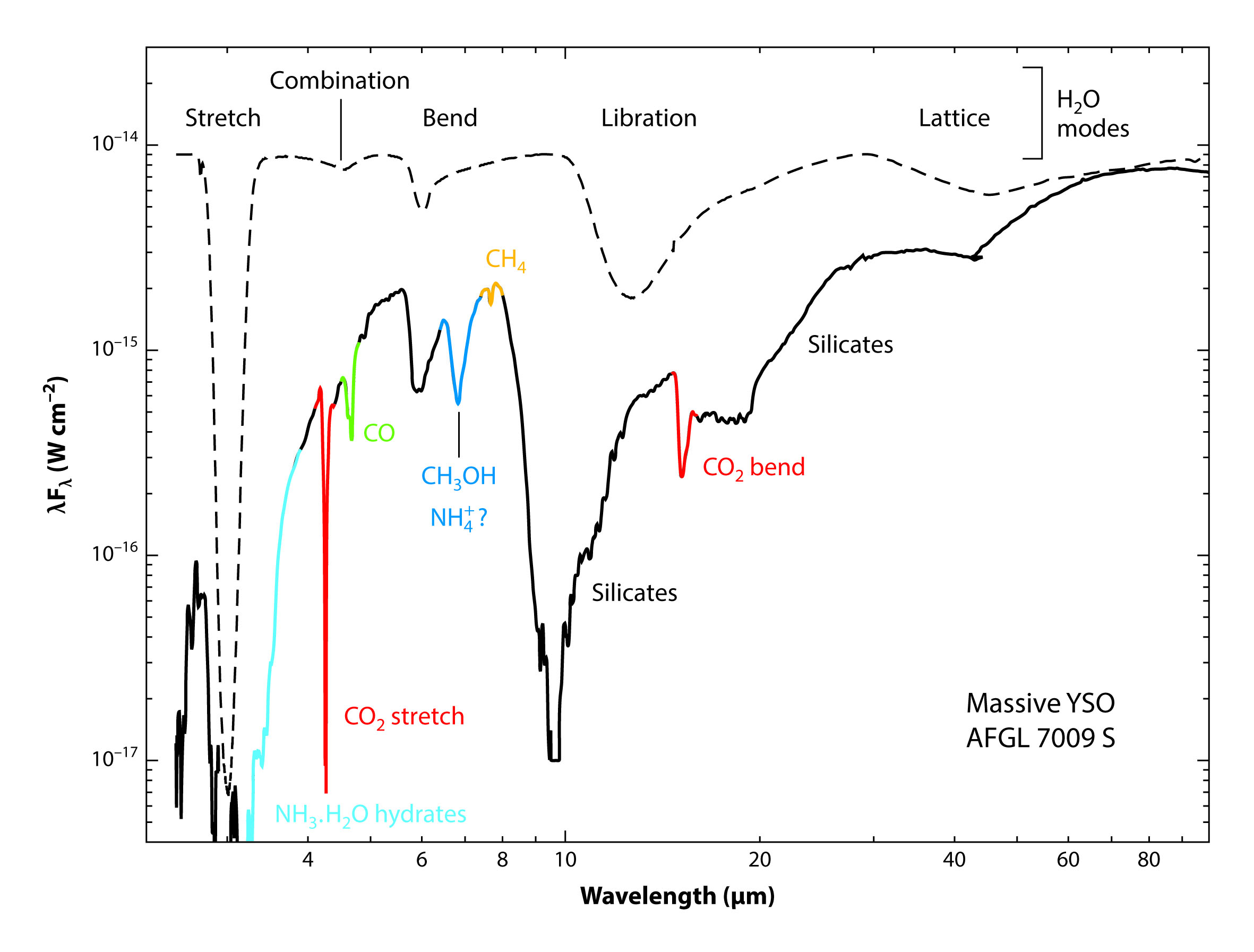 Figure 1. Ice and dust features in the massive young stellar object AFGL 7009S (Boogert et al. 2015, ARAA, 53, 541). Most of the interstellar and circumstellar ice studies focus on those stretch and bend mode vibrations, highlighted as absorption features.
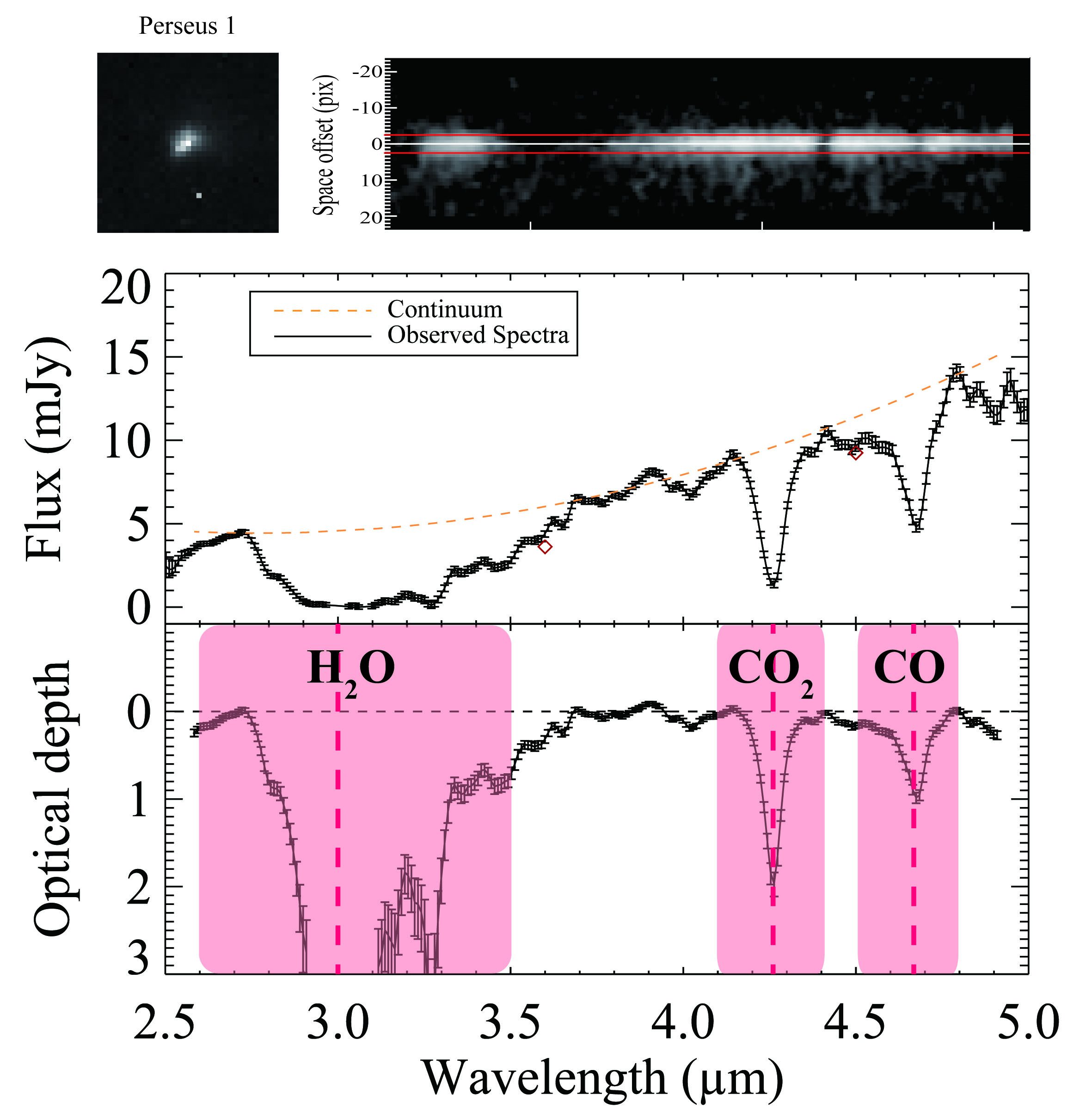 Figure 2. (Top) Reference (N3 filter) and spectral Images of the low-luminosity protostar, Perseus 1, with the reference frame of 1′× 1′ field of view. (Middle) The observed spectrum of Perseus 1. (Bottom) The converted optical depth profile of Perseus 1. Each absorption feature of ice components is highlighted (Kim et al. 2022).
Ice formation on dust grain surfaces has been considered as an important chemical process in the Universe. In dense clouds and circumstellar envelopes, chemistry on cold grain surfaces controls the composition of the icy mantles. Laboratory studies have suggested that the origin of complex molecular species can be found from the ice heating process through purely thermal reactions or energetic effect by ultraviolet photons and cosmic ray particles in star-forming regions. The observational studies of interstellar and circumstellar ices have traced the icy environments by their molecular vibrational transitions in the near- to far-infrared spectra.
Ground-based and space satellite observations for the studies of different icy environments have shown that the ice abundances reflect the differences in physical conditions and elemental compositions. In case of the envelopes of low-mass young stellar objects, the importance of ice abundances gives us a key to trace the evolution process between quiescent dense clouds and protoplanetary disks. Ice features detected in the low-luminosity young stellar objects (< 1.6 L☉) suggested the thermal history with episodic heating events, even in a quiescent phase of the accretion process.
In the near-infrared range (2.5~5.0 µm), absorption features of the most abundant ices (H2O, CO2, and CO) have been observed by the infrared camera aboard the AKARI space telescope. The AKARI ice survey performed the near-infrared spectroscopic observations toward the young stellar objects of various evolutionary stages and background stars with sensitive, but a low spatial resolution to cover the H2O, CO2, and CO ice features. This survey uses the grism mode with N3 filter and 1′× 1′ point source aperture to avoid confusion with other sources in the field of view. One of the goals of this survey is to compare ice features in various evolutionary stages of star formation from molecular clouds to Class 0, I, and II protostellar cores.
